
Clinical Solutions
Leadless pacemaker gains Health Canada approval
November 30, 2022
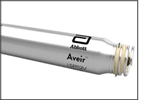 CALGARY – Nearly a decade of brainstorming, research and trials has paid off for a Calgary cardiologist and University of Calgary professor, who has received Health Canada approval for use of a new pacemaker. Dr. Derek Exner, associate dean of commercialization and innovation at the University of Calgary’s Cumming School of Medicine, and his team have been working closely with global healthcare company Abbott since 2014. Together, the group has been instrumental in bringing the Aveir VR leadless pacemaker to patients with heart conditions in Calgary.
The new technology is much smaller than traditional pacemakers, around the size of a AAA battery, and is easier to implant and replace, with a significantly longer battery life averaging around 15 years.
“These are tiny little devices that do everything that a traditional pacemaker does. Surprisingly, they can last longer than a traditional pacemaker despite their size, and the really neat thing about them is that the patients don’t even remember they have them after a while,” Dr. Exner told the Calgary Herald.
Teaming up with Abbott to bring the device to Canada was a natural fit for what Exner said he and his team wanted to accomplish; being on the leading edge of delivering the best possible heart rhythm therapies to patients across the country.
Unlike a traditional pacemaker, the Aveir VR is leadless, which means it doesn’t have wires connecting the device to the patient’s bloodstream and then to the heart. Older models are also bulky, can be bothersome for patients and expend a lot of energy.
“The beauty of this type of technology is that it gets rid of all those problems,” he said. “The device is placed directly into the heart, it’s a tiny little device and has a battery that, on average, lasts about 15 or 16 years from when it’s put in.”
Since Health Canada’s approval, Exner has installed about a half-dozen of the devices in patients outside of a clinical trial setting, and said people are coming to Calgary from across Canada for the surgery.
“Access to this is somewhat limited because of the (limited number of) people who can do it, and people who are trained to do it safely and appropriately,” he said.
“We have patients who are now sent from all over the province and outside the province to Calgary to receive this device because the doctors taking care of them say, ‘this is the best device for my patient’ . . . . My team and I are involved with not only making sure patients have access to this, but also training other physicians so that they’re able to provide this to their patients.”
Though it may be some time before all Canadians needing a pacemaker will get the Aveir VR, Exner said it’s been rewarding to see the outcomes of patients.
“I think the most important piece of this whole thing is it’s not infrequent to have patients come back to follow up and they say, ‘why am I here?’ They say, ‘well, because you have a pacemaker,’ and they say, ‘oh, I forgot I had a pacemaker.’
“For me, that’s one of the most rewarding things that I ever hear, is that the person is living their life, they’re happy, they’re able to do what they want to do.”