
Innovation
Is the time right for a made-in-Canada EHR, using the latest AI technologies?
October 30, 2026
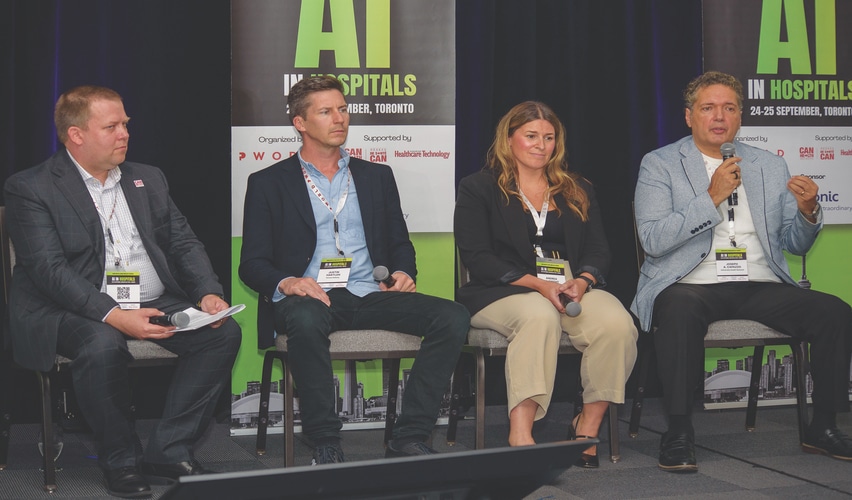
An odd thing happened at the AI in Hospitals Conference, held in Toronto the last week of September. There were the expected presentations of advances in AI in healthcare, and management advice for handling its surging presence.
But unexpectedly, a lively discussion was set off when one of the speakers noted that Canada’s expertise in AI provides an amazing opportunity to replace foreign-made healthcare IT systems with newer and better Canadian technology.
Joe Cafazzo, executive director of bioengineering at UHN, asserted that Canada is at the forefront of AI development, and now has a superb opportunity to foster and deploy Canadian-made AI solutions throughout the healthcare sector.
In fact, he opined that leading-edge companies like Cohere could even supplant traditional vendors of EHRs, as the nature of patient records is quickly changing. Said Cafazzo: “In the next few years, EHRs will become obsolete, and natural language will become the interface for all software.”
Canada shouldn’t lose out on the AI opportunity as it did in so many other healthcare technologies, he said, pointing to the discovery of insulin to treat diabetes and GLP-1 receptor agonists for weight loss. The production of insulin was transferred to US and British pharma companies, and GLP-1 discovery has been commercialized most successfully by Denmark’s Novo Nordisk. “We don’t want to see this happen again in AI,” said Cafazzo.
Justin Hartlen, co-founder of Virtual Hallway, a Halifax company that produced a platform enabling quick consults with specialists, outlined the difficulties of growing a new system in Canada. The platform is used by 10,000 physicians across the country, a significant number, but Hartlen noted there are 100,000 physicians in Canada and reaching them poses difficulties for a small firm. Marketing to the far bigger, international market is even more challenging.
Clearly, entrepreneurial startups need help – especially as they scale-up to reach a sizeable customer base. Predictably, the same thing would happen to an AI company creating a new EHR – unless it was already giant-sized and had deep pockets.
When it comes to giving these smaller companies a boost, Canadian hospitals, with their sizable I.T. budgets, could play a role.
That will require a culture change in hospitals, however, as Canada’s hospitals are largely risk averse and tend to avoid buying from small suppliers. Many a Canadian start-up has complained that hospitals here won’t even look at them until they’ve made sales in the U.S. and abroad.
Andrea McKnight, transformation healthcare leader at St. Joseph’s Healthcare Hamilton, asserted that Canadian hospitals and health organizations should use their buying power to promote Canada’s technology companies whenever possible. She said more hospital executives will need to get on board with this idea, stating that very few currently have this mindset.
Cafazzo observed that nurturing and strengthening Canadian companies is not only important for economic reasons, but for strategic ones. The current US president has shown he’s ready and willing to turn off the tech taps with countries like China and even Denmark when the mood strikes him.
It’s not unreasonable, he said, to think it could be done to Canada – as he has done in various areas during the trade war. For that reason, it’s better to have home-grown sources of technology, especially since Canadians have shown an ability to create breakthrough technologies.
The idea of a made-in-Canada, AI-enabled EHR isn’t as far-fetched as it may sound. In the next session, Kathy Malas, chief of AI and innovation at the Jewish General Hospital, in Montreal, discussed how her organization has created a new kind of EHR in partnership with Harris Arc Health; it will be rolled out in the Spring.
Malas described how the JGH aims to become Canada’s first AI-integrated hospital. The Electronic Health Record system is part of the plan. Not only will it contain AI abilities, but it will also integrate with its wider community of hospitals and health centres to create a comprehensive, longitudinal patient record. It’s doing this because none of the major EHR vendors offers this approach.
On the AI front, it has a high-powered platform that can support artificial intelligence applications – which consume a great deal of computing power.
It has also created an AI lab that will train staff, develop and test new systems before further testing in the hospital and community – what it calls its ‘living lab’. The goal is to solve the healthcare system’s pressing problems, such as the severe nursing shortage and too many ALC patients – all in a climate of a funding shortage.
To support innovation and AI, the hospital is re-designing its strategy, operations and services, so that AI is at the core and not bolted on. “It’s to improve value, quality, equity and efficiency,” she said.
Moreover, the Jewish General intends to share its solutions with others in Quebec and across the country. “We’re going to become an AI-first organization,” said Malas.
Most hospitals are investigating AI-based solutions and adopting them – some quickly, some more slowly. The question for all of them is, what area should they invest in first?
For its part, Trillium Health Partners, in Mississauga, Ont., is planning a big push into artificial intelligence. Last year, it announced a $25 million fundraising initiative in support of its AI for Better Health program, which aims to accelerate the development of new artificial intelligence tools.
But the issue remains, where to spend the money?
In a presentation at the AI in Hospitals conference, Dr. Laura Rosella, chief scientist at Trillium Health Partners, cautioned that simply implementing AI doesn’t automatically translate into value.
What’s more, she observed, AI isn’t ‘plug-and-play’ and often calls for a redesign of processes.
Part of the impetus for understanding and investing in AI at Trillium is to prepare for the opening of its new hospital site in 2030 – and what will become Canada’s largest hospital.
Nevertheless, Dr. Rosella said the giant hospital will still be filled to overcapacity “unless we do something significant.” That includes leveraging new technologies, like AI, to provide care more efficiently than ever before.
She explained the hospital is using the quintuple aim of healthcare to determine where to start deploying AI, and where it could make the most impact. Dr. Rosella observed that there are often trade-offs to be made – that if the patient experience is improved by technology, another part of the quintuple aim sometimes actually deteriorates.
As such, it’s important to measure AI’s impact on each area of the quintuple aim – patient experience, provider wellbeing, cost, population health and health equity.
She noted that like all areas of Canada, the Mississauga region is expected to experience rapid growth in the next 15 years, and with an aging population, a 70 percent increase in major illnesses is forecast.
A priority will be to treat patients at home and in the community whenever possible, and the hospital has already established a command centre in preparation for monitoring patients.
In planning its AI strategy, it seemed like caring for the frail and elderly at home would get the best bang for the buck and would be the natural area to target first. However, Dr. Rosella said the care pathways for its palliative care program were better developed and appeared to be more AI-ready. As such, it created an AI-driven solution for palliative care.
Even so, when the system was applied, it was discovered that some areas still needed improvement. “The patient experience was missed, and our clinicians were having a hard time,” she commented.
The team went back to the vendor for improvements. “The framework allows us to make adjustments, and it works much better now,” she said.
Meanwhile, the hospital is revising its patient pathways for community care and AI, and the experience it gained in palliative care was invaluable. The expertise will be applied to community care and running the new, 2.8 million-square-foot Peter Gilgan Mississauga Hospital.
In downtown Toronto, St. Michael’s Hospital, part of Unity Health Toronto, has been one of the most active proponents of AI, and its success shows the depth of talent and expertise that’s here in Canada. One of St. Mike’s success stories is ChartWatch, an early warning system that monitors patients in real-time and can predict if they’re going to crash. Through real-time early warnings, it has reduced the unexpected death rate by 26 percent.
The hospital has also produced an automated AI system for ED patients, checking head CTs to see if patients have suffered trauma to the brain or brain bleeds.
Most recently, St. Mike’s announced its leadership of VITAL, a project that will invest in infrastructure to connect 160 hospitals in three provinces – to begin with – and to make anonymized data available to researchers. VITAL is also sponsoring leading-edge clinical research projects, such as analyzing various types of drug use patterns across Canada’s hospitals to help determine best practices.
The VITAL network is operating under the leadership of two physicians from St. Mike’s, Dr. Fahad Razak and Dr. Amol Verma. It has attracted $210 million in funding from various levels of government, including an award of $100 million from Ottawa earlier this year.
AI thrives on large sets of data with a variety of patient populations, and VITAL’s shared data will provide just that. The aim is to improve healthcare delivery and to bring further research into Canada, such as drug trials.
Damian Jankowicz, PhD, Unity Health Toronto’s executive VP and CIO, spoke at the AI in Hospitals conference and described several leading-edge projects in AI. He also offered lessons from 10 years of work in this area. He said producing AI solutions not only requires data scientists, but also governance, integration and workplace transformation, too.
And it requires product management: “People don’t interact with AI, they interact with products,” he said. “So, the AI is only a small part of the whole solution.”
Most recently, St. Michael’s has been working on automating end-of-shift patient summaries for clinicians. These notes are particularly useful when patients are being moved to a different site or level of care – such as a nursing home or home care. If the notes are not available, the new caregivers may have trouble providing the right kind of care, which can lead to mistakes being made.
“Transitions of care can lead to errors when you don’t have the data you need,” said Dr. Jankowicz. The new project, he said, uses a Large Language Model (LLM) to scour all the patient’s nursing notes, labs, imaging reports and other documents to produce a report that’s available for the handoff.
The system also promises to be a big time-saver for physicians. “Normally, it takes doctors a long time to generate these notes,” said Dr. Jankowicz. “It slows down their work in the hospital.” By automating the process, doctors will have a lighter administrative load and more time for patients.
Zach Kilburn, chief digital officer at Horizon Health, in New Brunswick, had some advice for hospitals on when to start – and when to stop AI pilots.
While teams have lots of ideas about AI pilots, and hospitals are eager to launch them, you must know when to end them, too. “Not everything is going to work,” said Kilburn, adding that ending projects is not all bad. “Killing something that’s not working frees up capacity. Thankfully it doesn’t happen too often.”
So, how do you determine when to grow the project and when to kill it? Kilburn said you should scale up when: outcomes are improved; adoption is real; costs are understood; and operations can sustain it.
On the other hand, it’s time to pull the plug when: the problem changed; the workflow rejected it; value did not materialize; and the risk outweighs the benefit.
Kilburn gave examples of successful AI projects built in-house, including its pharmacy agent, to support medication and pharmacy workflows; a nursing agent, for answers to policy, practice and workflow questions; and the Horizon assistant, for faster access to organizational knowledge.